
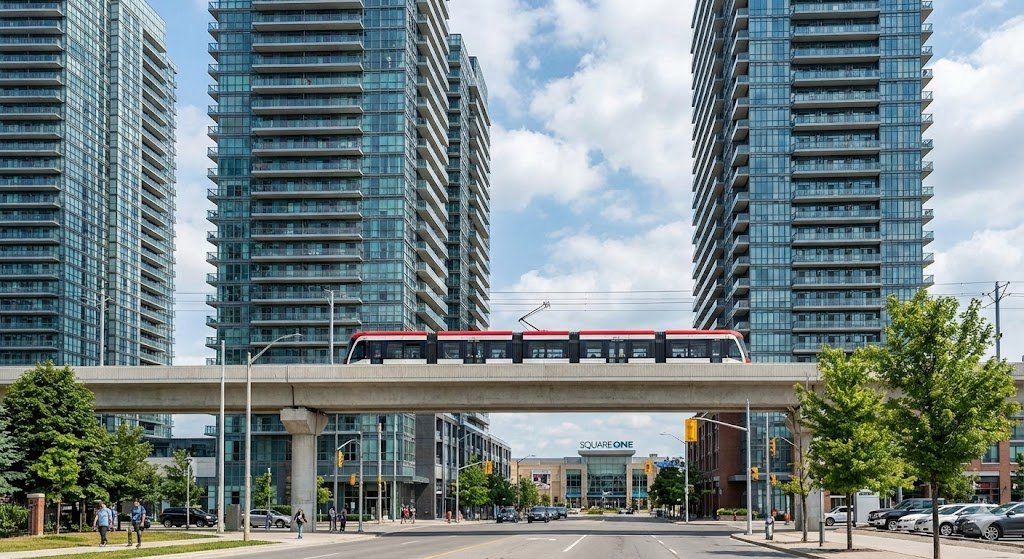
Mississauga used to be the place you moved when you wanted more space, a driveway, and you were fine driving everywhere. That was the trade. You got square footage. You accepted traffic. You memorized the on ramps.
But lately, there’s been a pretty clear shift. Not subtle either.
More and more condo projects are popping up right where transit is strongest. Around GO stations. Around the Hurontario LRT corridor. Near the main bus terminals. And not just one building here and there. We’re talking clusters. Entire pockets of the city getting denser, more walkable, more urban in the way people usually describe downtown Toronto.
This is the rise of Mississauga’s transit-oriented condos, such as those at Avia, Pinnacle Grand Park, Brightwater, Block Nine, and The Craftsman in Clarkson Village. This shift is changing what certain neighbourhoods feel like, what they cost, and who actually wants to live there.
Let’s talk about where it’s happening, why it’s happening, and what it means if you’re buying, investing, or even just trying to understand what Mississauga is turning into.
What “transit oriented” actually means in Mississauga
Transit oriented development usually gets shortened to TOD, and it sounds like planning jargon. It kind of is. But the idea is simple.
Build housing where people can realistically use transit every day.
Not “there’s a bus stop somewhere nearby.” More like you can walk to a major transit line, a station, or a rapid route in a few minutes, and that transit actually takes you somewhere useful.
In Mississauga, that typically means condos located near:
- GO Transit stations like Port Credit, Cooksville, Clarkson (close to The Craftsman Condos), Streetsville, Erindale, Meadowvale
- Major terminals like Square One (City Centre Transit Terminal)
- The Hurontario corridor where the Hazel McCallion LRT is being built, with stops connecting Port Credit to Brampton
- High frequency MiWay routes that feed into those bigger hubs
TOD also usually comes with a certain vibe. More density. More mixed use. More retail on the ground floor. More people walking around at night grabbing food, not just driving home and disappearing into a garage.
And this is the part that surprises some people. Mississauga is actually a pretty good fit for it now because the “centres” are already there: Square One, Port Credit, Cooksville, Streetsville – these aren’t random intersections. They’re real nodes.
Why transit oriented condos are the sought after choice right now
A few things are converging at once. And it’s creating a kind of perfect storm for condo development around transit.
1) Toronto prices pushed demand outward, but not everyone wants car dependent suburbia
A lot of buyers still want to be in the GTA, but they’ve mentally tapped out on Toronto pricing. Or they just want more value for the same budget.
Mississauga fits. It’s close. It has jobs. It has schools. It’s familiar.
But the modern buyer also wants convenience. They want to walk to coffee. They want a gym downstairs. They want a train nearby. Especially younger professionals and downsizers.
Transit oriented condos like the Westport condos in Mississauga satisfy that without forcing them into downtown Toronto.
2) The LRT is a huge psychological shift
Even before the LRT fully opens, it changes how people think about the city. The corridor becomes a “spine.” Developers plan around it. Buyers start imagining a lifestyle around it.
And it’s not just imagination. A north south rapid route through the city is the kind of infrastructure that reshapes land values. Slowly, then all at once.
3) Cities are under pressure to intensify, and TOD is the cleanest way to do it
Mississauga is mostly built out. You can’t just keep expanding forever. And the province has been pushing housing supply, approvals, density. Everyone’s talking about it.
So the question becomes, where do you add housing without breaking everything?
Near transit is the logical answer. That’s the whole point of Transit Oriented Development (TOD). Put more people where you already have mobility and services.
This is where developments like Grande Mirage condos, Keystone condos, and Daniels Erin Mills condos come into play, providing desirable living spaces that align with these new commuting patterns and lifestyle preferences.
4) Investors like stations. End users like stations. Everyone likes stations
Rental demand tends to be strongest near transit. That’s true in almost every market.
Tenants want options. They might not have a car. Or they might have one but hate commuting. Either way, being close to a GO station or rapid transit corridor is a selling point that stays a selling point.
For buyers, it’s also a bit of a safety blanket. Even if the market cools, “walk to GO” is still a strong feature to put on a listing.
The neighbourhoods where you can really feel the shift
There are a few areas in Mississauga that are basically the poster children for this trend. Some are already established. Some are mid transformation. Some are about to change a lot.
1) Port Credit: lake, GO station, and a condo pipeline that isn’t slowing down
Port Credit has always had charm. The marina. the restaurants. the lakefront trails. It already felt like a place people wanted to be outside of pure convenience.
But the transit piece is what turned it into a condo magnet.
Port Credit GO gives you a direct line into downtown Toronto. Add the future LRT connection nearby, and suddenly Port Credit becomes a legit transit hub, not just a cute lakeside neighbourhood.
Condo living here is not the “cheap alternative” to Toronto. It’s its own premium. People pay for the lifestyle. Investors like it too because rentals in Port Credit have a different tenant profile. More professionals, more couples, more people willing to pay for walkability.
One thing to watch. With all the development, the feel can change. More towers means more people. More traffic. More competition between buildings. It’s not automatically bad, but it’s part of the trade.
2) Cooksville: quietly turning into a serious transit first node
Cooksville is interesting because it doesn’t have the postcard lakefront vibe. It’s more practical. More central. And historically, it was kind of overlooked.
Not anymore.
Cooksville GO is one of the biggest drivers here. Plus, you’re close to Square One, which is a major hub with numerous new condo proposals and a lot of interest from people who want “access” without paying Port Credit premiums.
The connectivity is honestly very strong. You’re also close to Hurontario, the QEW and 403. Cooksville has room to grow, and the city has been eyeing it for intensification for years. If you want to understand what TOD looks like in its early to mid stage, Cooksville is a good case study.
3) City Centre (Square One): already dense, getting denser, basically Mississauga’s downtown
If you’re new to Mississauga, City Centre can feel like a different city than the rest of Mississauga. Tall buildings. wide roads. constant construction. People actually walking around.
Square One is not just a huge hub for shopping; it’s also a transit terminal, near Sheridan College, packed with offices, condos including planned mixed use communities, and a variety of condos at Nahani Way and Hurontario.
This is where the “live work transit” concept is most obvious. You can live in a tower, walk to groceries, catch a bus to multiple directions, and you’re not totally dependent on a car.
It’s not perfect. Some parts are still very car oriented because the roads are massive and intersections can feel hostile on foot. But the direction is clear: More density, more pedestrian upgrades, more transit integration.
If Port Credit represents lifestyle plus transit, City Centre embodies convenience plus scale with its vast array of condo options in Erin Square and Avia condos in Parkside Village.
4) Hurontario corridor: the LRT effect in real time
This one deserves its own category because it’s less about one neighbourhood and more about a line. A corridor transformation.
Hurontario runs north south and connects a bunch of key areas. Port Credit, Cooksville, Fairview, City Centre, up to the Brampton border.
Condos along this corridor are being marketed with the LRT front and centre. Even if the stop is a 7 minute walk. Even if the LRT is not fully operational yet. It’s part of the pitch.
And honestly, it will matter.
Transit corridors tend to pull development toward them. Land values adjust. Retail follows rooftops. Eventually, the corridor feels like a continuous urban strip, not a set of disconnected intersections.
If you’re choosing a condo along Hurontario, such as the Amber Condos, it’s worth thinking long term. The area will likely look very different in 5 to 10 years. Maybe better. Maybe busier. Usually both.
5) Meadowvale and Streetsville: GO access with a more suburban vibe
Not every transit oriented condo pocket is high rise central. Meadowvale and Streetsville have GO stations and a different feel. More suburban, more family oriented. More greenery.
But the GO connection is powerful. Especially for commuters.
You see condo developments and mid rise projects around these stations because it makes sense. People want access to the train without living in a downtown tower cluster.
These areas can appeal to downsizers too. People who want to stay in Mississauga, maybe sell a larger home, and move into something easier. But still be near shops, parks, transit.
Who is actually buying these transit oriented condos
You tend to see a few buyer profiles show up again and again.
First time buyers who want a lifestyle, not just a unit
A lot of younger buyers are not dreaming of a detached home right away anymore. They want a decent condo, near transit, near restaurants, maybe near a gym. They want to get into the market and keep life flexible.
Mississauga near transit gives them that. With the bonus that the commute to Toronto is still doable. Properties like The Anchors at Lakeview condos, Tanu condos, and Canopy condos offer such lifestyle choices.
Investors, but the slightly more careful kind
Transit oriented condos attract investors because rental demand is more resilient near stations and major routes.
But investors are also more cautious now. Higher interest rates over the last couple years, stricter cash flow math. The investor buying today tends to care about.
- Is this unit rentable fast
- Is the building near a real transit hub or just “close”
- Will there be too much supply competing nearby
- What is the long term neighbourhood plan
They’re not just buying anything that launches.
Downsizers who want to stay in the city, not leave it
This is a big one. Mississauga has a lot of long time homeowners. When it’s time to downsize, many want to stay near family, doctors, familiar shops. They just want less maintenance.
Transit oriented condos in Port Credit, City Centre, Streetsville, even Cooksville, give them a “walk to everything” option without leaving Mississauga. Options like Keystone at Kaneff condos and Perla condos provide such convenience while allowing them to remain in their beloved city.
What to watch out for before buying in a transit focused condo pocket
Transit oriented sounds like a guaranteed win, but it’s not automatic. A few things can trip people up.
Being “near transit” is not the same as being near good transit
A listing might say “steps to transit” and technically it’s true. But you want to look closer.
- Is it a GO station or just a bus stop
- How frequent is service
- Is the walk comfortable and safe, especially at night
- Is there a huge road crossing involved
- Is the route useful for your actual commute
Sometimes a 12 minute walk feels fine. Sometimes it feels brutal because you’re crossing an eight lane road with icy sidewalks.
Construction fatigue is real
If you buy in an area with multiple towers planned, you might be living in a construction zone for years. Noise, dust, blocked sidewalks, street closures.
Not forever. But long enough that you should factor it into your decision, especially if you work from home.
Oversupply in one pocket can flatten resale or rentals short term
If five buildings complete around the same time, competition spikes. Rents can soften. Resale listings can sit longer.
Long term, transit hubs usually do well. But the short term can be choppy, especially in high development zones.
Condo fees and amenities can get out of hand
Some newer buildings load up on amenities to compete. Pools, co working lounges, fancy concierge setups.
It sounds great. Until you see the fees. Or until half the amenities are underused but still expensive to maintain.
Look at the full cost of ownership, not just the purchase price.
So what does this mean for Mississauga, overall
Mississauga is becoming more multi-centered. It’s not just one downtown surrounded by endless suburbs anymore. Instead, it’s a series of nodes connected by transit.
We can see Port Credit evolving into a lakefront urban village, City Centre transforming into a high-rise core, Cooksville emerging as a transit-connected growth area, Streetsville maintaining its historic small-town feel with GO access, and Meadowvale serving as a suburban node with commuter strength. The Hurontario corridor is tying all these areas together.
Transit-oriented condos are basically the physical manifestation of that shift.
And this trend is going to continue, because the demand is still present and the planning logic remains sound.
However, it won’t be without challenges. Some areas may feel too dense too quickly, certain streets may lag behind in pedestrian upgrades, and some developments might be better designed than others.
But the direction is clear. Mississauga is building up around mobility.
FAQ: Mississauga Transit Oriented Condos
What is a transit oriented condo, exactly?
A condo built within a short walk of major transit, usually a GO station, rapid transit line, or a major terminal, so residents can realistically commute without relying on a car.
Which Mississauga areas are best for transit oriented condo living?
Port Credit, Cooksville, City Centre (Square One area), and locations along Hurontario are the most obvious choices. Streetsville and Meadowvale also play significant roles due to their GO access and more suburban feel.
You can find some great condos for sale in Mississauga in these areas.
Are condos near GO stations always a good investment?
Often they are, but not always. They usually have stronger rental demand and resale appeal. However, factors like short-term oversupply, high condo fees, and long construction periods can affect performance negatively.
For those considering investing in such properties, exploring options like Tempo condos or Hillcrest condos could be beneficial given their strategic locations and potential for value appreciation.
How will the Hurontario LRT impact condo values?
Typically, major transit projects increase demand and development along the corridor over time. The biggest impact tends to show up gradually as the line becomes fully operational and the area densifies around stops.
What should I check before buying near transit?
Look beyond the marketing. Confirm walking distance, service frequency, safety and comfort of the walking route, planned construction nearby, and the building’s fee structure and reserve fund health.
Is Mississauga becoming more like Toronto?
In certain pockets, yes. Especially around City Centre, Port Credit, and the Hurontario corridor. But it’s still more spread out overall, and it’s evolving into multiple dense nodes rather than one single downtown.


Join The Discussion